Private by Default: Helping Young People with Intellectual Disabilities Protect Their Personal Information Online
A home address in a profile bio, a school uniform in a selfie, a location tag on a story. Each of these seems harmless on its own. Together, they can tell a stranger exactly who a young person is, where they live and when they are alone. For young people with intellectual disabilities, protecting personal information is one of the most important online safety skills, and one of the least taught.
Why privacy is a particular challenge
Young people with intellectual disabilities use the internet for the same reasons as their peers: friendship, entertainment and belonging. Research shows, however, that they often face barriers in judging online risk. These include difficulty with abstract ideas such as “audience” or “permanence”, and a strong wish to be accepted socially (Chadwick, Wesson & Fullwood, 2013). Studies of young adults with intellectual disabilities find that many share personal details with online contacts they have never met in person (Jenaro et al., 2018).
This matters because personal information is what people who seek to exploit young people collect first. Research on cybervictimisation shows that young people with intellectual or developmental disabilities are particularly exposed to sexual solicitation, which often begins with requests for apparently ordinary information (Normand & Sallafranque-St-Louis, 2016). The CO:RE “4Cs” framework describes this as a contact risk. These risks develop over time through exchanges that slowly build trust, not through a single dangerous moment (Livingstone & Stoilova, 2021).
Privacy is a right, not only a risk
Privacy should not be presented only as a list of prohibitions. The UN Convention on the Rights of Persons with Disabilities protects the right to privacy for persons with disabilities on an equal basis with others (Article 22) and the right to access information (Article 21). In the EU, the Digital Services Act requires online platforms accessible to minors to put in place appropriate measures for their privacy, safety and security. It also requires all platforms to offer easy-to-use reporting tools (Regulation (EU) 2022/2065, Articles 16 and 28). Young people have the right to use these tools, and they should be shown how.
Five practical steps for educators and carers
- Use the “front door” test. Ask: “Would you tell this to a stranger at your front door?” A concrete comparison works better than abstract rules.
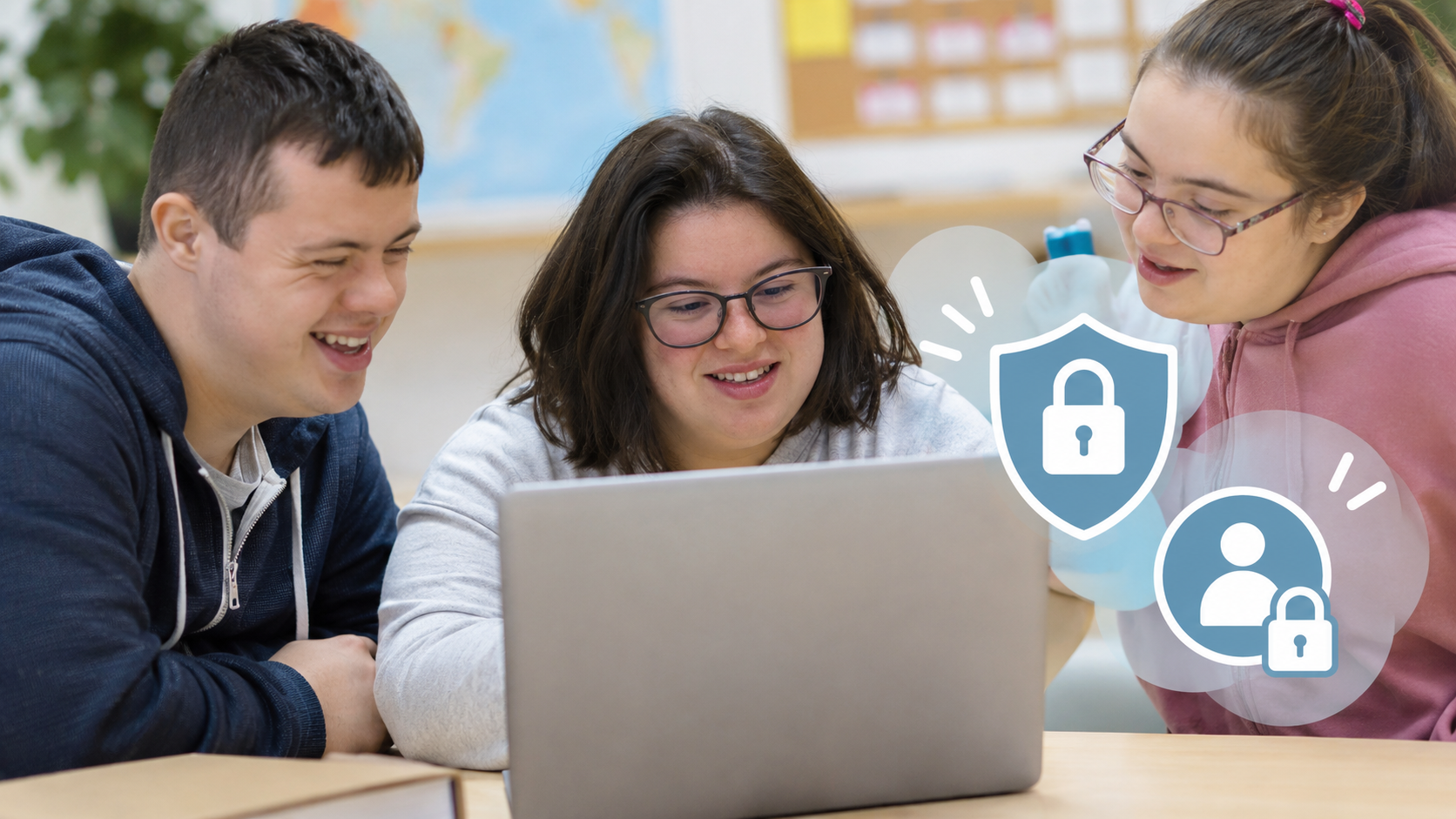
- Check settings together. Sit down with the young person and set accounts to private, turn off location sharing and review who can send messages. Repeat this after every app update.
- Make a “private list”. Together, write down information that stays offline: full name, address, school, phone number, passwords and photos showing these details.
- Practise saying no. Role-play requests such as “Where do you live?” or “Send me a photo” and rehearse calm, short replies.
- Teach the report button. Show where the block and report functions are on each platform the young person uses, and make clear that reporting is never “getting someone in trouble” unfairly.
Easy-to-read materials, short videos and repetition make these skills last (Inclusion Europe, 2009).
Conclusion
Protecting personal information does not mean withdrawing from digital life. It gives young people with intellectual disabilities the confidence to participate safely, on their own terms. PRISCILLA’s educational programme and training materials for professionals and caregivers support exactly this goal.
References
Chadwick, D., Wesson, C., & Fullwood, C. (2013). Internet access by people with intellectual disabilities: Inequalities and opportunities. Future Internet, 5(3), 376–397.
Inclusion Europe. (2009). Information for all: European standards for making information easy to read and understand. Inclusion Europe.
Jenaro, C., Flores, N., Cruz, M., Pérez, M. C., Vega, V., & Torres, V. A. (2018). Internet and cell phone usage patterns among young adults with intellectual disabilities. Journal of Applied Research in Intellectual Disabilities, 31(2), 259–272.
Livingstone, S., & Stoilova, M. (2021). The 4Cs: Classifying online risk to children (CO:RE Short Report Series on Key Topics). Leibniz-Institut für Medienforschung | Hans-Bredow-Institut.
Normand, C. L., & Sallafranque-St-Louis, F. (2016). Cybervictimization of young people with an intellectual or developmental disability: Risks specific to sexual solicitation. Journal of Applied Research in Intellectual Disabilities, 29(2), 99–110.
Regulation (EU) 2022/2065 of the European Parliament and of the Council of 19 October 2022 on a Single Market for Digital Services (Digital Services Act). Official Journal of the European Union, L 277, 1–102.
United Nations. (2006). Convention on the Rights of Persons with Disabilities. United Nations.