
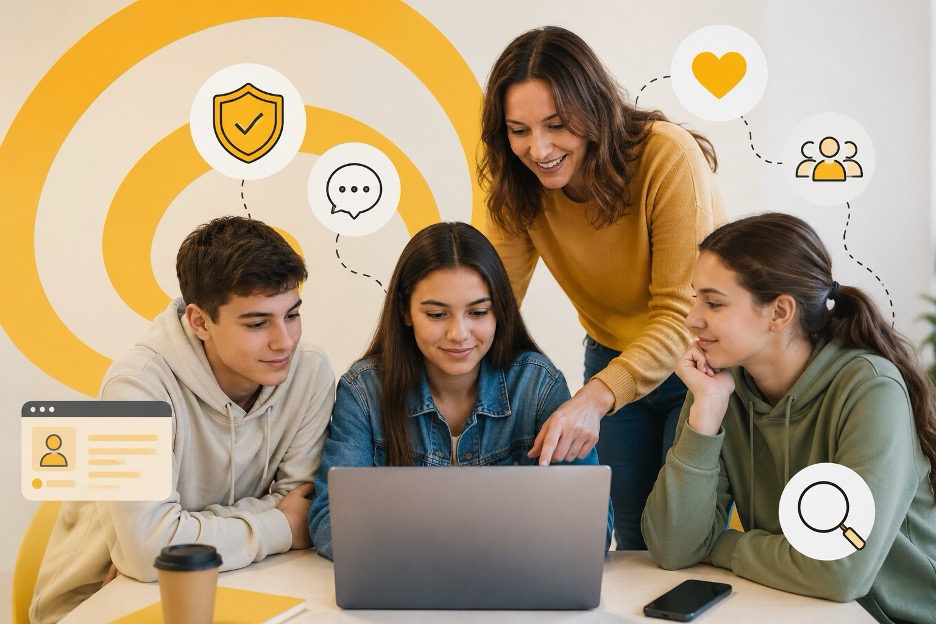
Spot cyberbullying. Stop cyberbullying. Support youths.
A message appears on the screen.
Then another.
What starts as a joke quickly becomes a stream of hurtful comments, fake profiles, or threatening messages.
For many young people, this is the reality of cyberbullying, a type of bullying that doesn’t end when the school bell rings.
For youths with disabilities, the risks can be even greater.
Communication barriers, social isolation and greater reliance on digital technologies may increase their vulnerability to online abuse.
Yet the same technology that can expose young people to harm can also become one of the most powerful tools for protection.
Research from UNESCO (2021), UNICEF (2020) and the World Health Organization (2022) consistently shows that preventing cyberbullying requires a combination of accessible communication, digital literacy, thoughtful monitoring and supportive adults who know when and how to step in.
Creating safer online spaces begins by giving every young person the ability to communicate, report concerns and confidently navigate the digital world.
Giving every young person a voice
Imagine not being able to explain that someone is bullying you online.
For many young people with complex communication needs, this may be a reality.
Augmentative and Alternative Communication (AAC) gives them a way to express themselves through devices, apps, symbols and communication systems:
- Moderated messaging platforms
- Speech-to-text, text-to-speech and screen readers
- Educational games on online safety
- Picture Exchange Communication Systems (PECS)
- Symbol-based communication apps
- Low-tech communication boards
Research from ISAAC (2026) and ASHA (2026) shows that AAC promotes participation, independence and social inclusion: key factors in reducing vulnerability to cyberbullying. By removing communication barriers, AAC helps young people report abuse, seek support and participate safely and confidently online.
Technology can help, but it can’t replace people
Technology doesn’t understand context the way people do.
A sarcastic joke between friends may be interpreted as harassment, while subtle bullying can sometimes go unnoticed. That’s why experts recommend combining automated monitoring with human oversight.
The World Health Organization (2022) emphasizes that the most successful approaches bring together technology, education, families, schools and communities to create supportive digital environments.
For young people with disabilities, monitoring strategies should also:
- Be adapted to different communication needs
- Respect privacy while ensuring safety
- Allow anonymous reporting of bullying
- Include regular evaluation and feedback
- Record repeated incidents to identify ongoing patterns of abuse
The objective is not surveillance, it’s early support.
Your social media already has safety tools. Are you using them?
Many people don’t realise that the platforms they use every day already include powerful tools to reduce online risks.
Whether it’s Instagram, TikTok, Facebook, YouTube, or other social media, a few simple settings can dramatically improve online safety.
Take a few minutes to:
- Explore “Meta Family Centre” for Facebook and Instagram
- Understand “Family Pairing” for TikTok
- Turn on “Restricted Mode” on YouTube (Google Family Link)
- Filter offensive comments, available on all social media
- Make your account private, protect your personal information
- Limit who can contact or follow you
- Remove suspicious followers/friends
- Block fake or abusive accounts, report them
- Report harassing comments instead of answering them
- Check your privacy settings regularly, especially after updates
According to UNICEF (2020), learning how to use these built-in safety features is one of the simplest and most effective ways to reduce exposure to cyberbullying.
Could you spot a fake profile?
At first glance, everything looks normal.
Even the profile photo seems real.
But something doesn’t feel right.
Fake accounts are often used for trolling and other kind of cyberaggression.
Fake profiles are no longer easy to spot.
AI-generated images and stolen photos make fake profiles harder to recognise.
These accounts are often used to impersonate others, spread misinformation, or engage in cyberbullying through hostile comments and offensive posts. Encourage young people to look for digital patterns, such as unusual activity, contradictory information, or aggressive behaviour, so they can spot a fake profile.
Building a kinder digital future
Cyberbullying isn’t just a technology issue; it’s a human issue.
The evidence is clear: creating safer online communities requires empathy, education, effective communication, and responsible digital citizenship. When young people feel safe asking for help, they are better equipped to recognise risks, respond to harmful behaviour, and support one another online.
Youths deserve to feel heard and safe. And together, we can build a digital world where respect and kindness are just as powerful as technology itself.
References
- ASHA – American Speech-Language-Hearing Association (2026). Augmentative and Alternative Communication (AAC).
- ISAAC – International Society for Augmentative and Alternative Communication (2026). What is AAC?
- UNESCO (2021). Creating Safe Digital Spaces.
- UNICEF (2020). Cyberbullying: What Is It and How to Stop It.
- WHO – World Health Organization (2022). What Works to Prevent Online Violence Against Children?